Intro — a draw that breaks habits, but not the jackpot
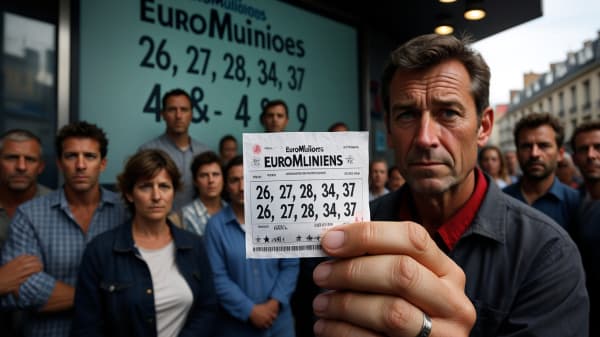
The EuroMillions draw of 3 February 2026 proposed a jackpot of 17 million euros and ended without winning row 1: no one found the complete combination (5+2). The numbers released — 26, 27, 28, 34, 37 and Stars 4 and 9 — offer a remarkable configuration: a series of three consecutive numbers and, above all, all the main numbers are in the top half of the grid (beyond 25). This draw comes after 19 consecutive draws without winning in row 1, a sequence of postponements which once again did not allow to create a great winner.
- Number analysis — a series and a "all-high" profile
The most striking feature is the continuation 26–27–28: three neighbours fell together, a pattern less frequent than more dispersed distributions and which gives the draw a strong readability. Another notable element is the up/down distribution (>25 / ≤25) of 5.0. A draw consisting solely of numbers of the upper half (26–50) is unusual and significantly alters possible combinations.
Of the 50 prints analysed, none of the five main issues this evening are in the top five of the "hot" (13: 10 appearances, 44: 9, 5: 8, 8: 8 and 17: 8). Numbers released are of average occurrence: 26 appears 6 times over the period, 27 and 34 5 times each, 37 4 times and 28 3 times. Rather than a draw dominated by "hot" values, it combines a moderate frequency with a marked positional logic (near and up).
The even/unfair composition (three pairs, two odds) is not extreme, but associated with all the numbers in the upper half, it gives an unusual imprint: a high hand, slightly dominated by the peers. Stars 4 and 9 do not emerge from the frequency series studied; they complete the combination without neutralizing it.
- What "hot" and "cold" say — useful reading for players
The observation of frequencies over 50 draws reminds us that "hot numbers" do not systematically dictate outputs: none of the five main numbers is in the top 5, which shows that cycles can untie quickly. Conversely, the "cold" (1, 3, 16, 19, 20, with only two appearances) remain absent: no "major cold" was "unlocked" tonight.
This mixture — the absence of hot/cold extremes and the presence of a consecutive triad — illustrates a practical lesson: prints do not necessarily complement a hot series or require cold numbers to reappear. Randomity can produce local (consecutive, at the top) patterns independent of the large trends observed on a sample.
- Detail of winnings — who wins what and what it means for the pool
No winner in row 1 (5+2): 0 winner, jackpot kept at 17 million euros. Rows 2 (5+1) and 3 (5+0) also remained blank — 0 winner in both cases — while the historical average over the period was 1.22 and 3.06 winners respectively. This draw was therefore poor in very large batches, which fuel the continuation of the postponements.
Among the gains paid:
- Rank 4 (4+2): 3 winners, each receives €1,906.70;
- Rank 5 (4+1): 82 winners, 162.90 € on average;
- Rank 6 (4+0): 202 winners, 53.50 € on average. The long trail of small wins remains dominant: 67,441 players in row 11 reach €5.90, and 152,745 in row 12 receive €4.30. In the absence of big winners, the redistribution mainly benefits thousands of players getting some good numbers.
- Conclusion and look to next draw
Three concrete lessons emerge from the 3 February draw. First, the 26–27–28 alignment and the 5 highs / 0 low configuration are the highlights: rare patterns that mechanically disadvantage grids composed mostly of small numbers. Then, the lack of winners in ranks 1 to 3 despite 19 postponements confirms that the riders do not guarantee an explosion in the number of winners: variance remains decisive.
Finally, the next draw is estimated at EUR 77 million — a significant leap if the estimate is confirmed. For players and observers, two elements deserve to be followed: the high/low proportion of future draws (a repeat of "all up" draws would be a short series) and the possible reappearance of consecutive patterns. Practical reminder: do not overestimate "hot"; Local configurations (neighbours, high or low concentration) alone can change the outcome of a draw.
In short: not a millionaire tonight, but a draw marked by a sequence of neighbours and an entirely "high" map that recalls the unpredictability of the lottery.